Tuesday, 27 September 2011

Philippines cleans up after Typhoon Nesat

Road in Manila littered with debris after Typhoon Nesat  
Teams are gradually clearing the streets of debris left by the typhoon
A huge clean-up operation is under way in the Philippines after Typhoon Nesat battered the capital Manila and the main island, Luzon.
The death toll rose to 18 with 35 still missing after heavy rain and powerful winds triggered storm surges.
Most deaths occurred in and around Manila, officials said.
Nesat is now in the South China Sea with 120km/h (75mph) winds and due to reach China's Hainan Island on Thursday evening or early Friday.
Power supplies were gradually being restored to central Manila on Wednesday, officials said, and services on the Metro resumed.
However, more than a million people in Luzon remained without power.
Emergency teams were clearing away fallen trees, debris and broken-down cars while schools and offices reopened.
Civil defence chief Benito Ramos said crews were also repairing and clearing 61 road networks across Luzon damaged by landslides, debris and flooding.
Some areas are still under water including Manila Ocean Park and Taft Avenue. The US Embassy, which was flooded on Tuesday, remained closed.
City Mayor Alfredo Lim said huge waves had breached the sea wall allowing water from Manila Bay to engulf wide areas.
"This is the first time that this kind of flooding happened here," he said.
Flooding in Luzon was made worse when the government released water from four dams that had reached critical levels in Bulacan province.
Meanwhile, another tropical storm brewing in the Pacific Ocean could hit the Philippines within the week, the state weather bureau warned.
"We need to finish emergency work in the aftermath of Nesat before this storm comes," Mr Ramos said.
"We are praying for the skies to clear a little bit today."
Nesat, which had a diameter of 650km (400 miles) and carried gusts of up to 170km/h (105 mph), made landfall just before dawn on Tuesday on the Pacific coast.
The Philippines suffers frequent typhoons but Nesat is thought to be the largest this year.
It comes almost exactly two years after Typhoon Ketsana killed more than 400 people.

Philippines map

Powerful Typhoon Nesat hits Philippines

A powerful typhoon has struck the Philippines, triggering floods and cutting power in the capital Manila and throughout the main island, Luzon.
Typhoon Nesat also forced the closure of the Philippine Stock Exchange and the US embassy, and the ground floor of Manila's main hospital was flooded.
At least seven people have been killed, including several children.
As Nesat approached, the authorities ordered the evacuation of more than 100,000 in central Albay province.
The typhoon is expected to continue slowly across the country, before blowing across the South China Sea towards southern China on Thursday.
There has been really heavy rain and wind here since last night. The typhoon seems to have been moving from east to west of the island of Luzon and affecting large parts of it. And when you think that Luzon is home to more than half the Philippine population it means that a lot of people have been affected.
There are a lot of very poor people in the country, and I was filming in some of the poorer areas of Manila yesterday, in low-lying slums. There was a little rain during the day and already the homes were being flooded.
Now we're a day on and it's been raining solidly since then. There must be real fears for people living in those kinds of areas.
Crushed
Nesat made landfall just before dawn on Tuesday in the eastern Isabela and Aurora provinces on the Pacific coast.
The storm - with a diameter of 650km (400 miles) and wind gusts of up to 170km/h (105mph) - is now making its way across Luzon, Kate McGeown in the central Luzon province of Zambales reports.
Many roads have been flooded and flights cancelled, and local media are urging people against non-essential travel, our correspondent says.
An adult and three children were crushed to death as a building collapsed in a northern Manila suburb on Tuesday, AFP news agency quoted the Office of Civil Defence as saying.

Philippines map 
Two men were said to have died north of the capital in a landslide and weather-induced accident.
There is waist-deep flooding in parts of the capital.
Reporters described huge waves crashing into Manila Bay's seawall, with water overflowing into Roxas Boulevard and flooding streets and parks around the US embassy, which was evacuated.
The ground floor of Manila hospital was flooded, and staff were forced to move patients to the first floor.
"We've heard of Manila Hospital being flooded, but we're struggling to reach the area even though we've co-ordinated with them already to help in an evacuation plan," Philippine National Red Cross secretary general Gwen Pang told AFP.
A five-star hotel was also evacuated, reports said.
Meanwhile, thousands of residents living inland along the Marikana river were evacuated as it threatened to overflow.
Government offices, schools and universities were closed.
In Isabela province, four coastal towns under threat from storm surges have been evacuated.
Four fishermen are missing, and more than 50 more have been rescued after their boats capsized in rough seas.
There are fears that the death toll may rise further.
Late on Monday, the first reported casualty of the typhoon was a baby who fell into a swollen river in the eastern province of Catanduanes.
Children evacuated from shanty towns - 27 September  
Tens of thousands of people are being evacuated in Luzon
Earlier, about 110,000 people in several towns of the Albay province were ordered to leave their homes and seek shelter elsewhere.
"We can't manage typhoons, but we can manage their effects," provincial Governor Joey Salceda was quoted as saying by the Associated Press.
The Philippines suffers frequent typhoons, about 20 a year, but Nesat is thought to be the largest this year.
It comes almost exactly two years after Typhoon Ketsana killed more than 400 people.

Friday, 23 September 2011

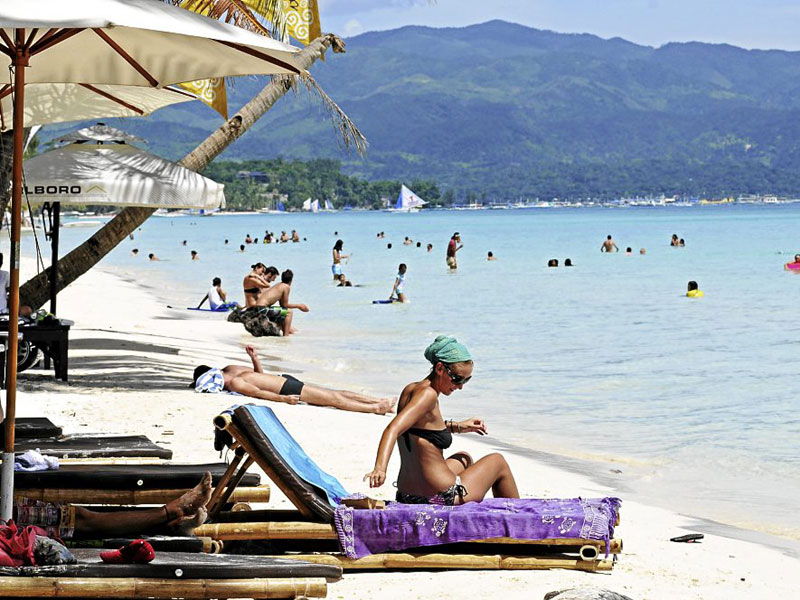
DENR, local execs vow to protect Boracay


MANILA, Philippines—Environment and local officials on Friday vowed to keep Boracay on the top of the country’s list of most attractive destinations amid competition from other destinations.
Environment Secretary Ramon Paje and Boracay Mayor John Yap said measures have been put in place to keep the resort-island’s beachfront clean and litter-free.
“We will never allow Boracay to fall. We will never allow Boracay to be dirty,” Paje said in a media interview.
Paje said Boracay officials and establishments should make sure that the island’s fine powdery white sand stays pristine.
Local officials should also guarantee that garbage and sewerage are disposed of properly and developments should be environmentally sustainable, Paje said.
“We are encouraging tourism. We have to put sustainable measures that will not destroy the environment,” he said.
Paje noted that Boracay still has the capacity to handle more tourists. He said the beach destination could still double the 800,000 tourists it attracts every year.
“We are still small compared to Phuket and Malaysia,” he said.
Recently, Boracay banned smoking on the beaches and instituted an anti-litter campaign. “We have to maintain the beachfront because that is the main attraction,” he said.
Yap also noted that the island will launch a massive greening project. According to the town mayor, each of the 4,000 grade school students of the island will plant seedlings. This is part of the government’s national greening program, he said.

Sex strike brings peace in Mindanao Island

Manila, Sept 19 Women in a village in the Philippines are being hailed as the heroines after they successfully brought peace to their community. Wives of feuding men in Dado village which is located near the troubled island of Mindanao used sex as the means to get their husbands back on the peace track.
The United Nations High Commissioner for Refugees announced on Friday that the women embarked on sex strike to demand peace in the community. The strike started last July and the UNHCR says some peace has returned to the land and the community has started making some progress.
The global agency has denied any involvement in the decision of the women stating that the women came up with the idea on their own.
The National Officer of the UNHCR in the Philippines, Rico Salcedo told the AFP that, “The area is in a town which is subject to conflict, family feuds, land disputes. The idea came personally from the women.”
It is believed that a group of women engaged in sewing came up with the idea because it was hampering their business. One woman who took part in the strike narrated that she warned her husband that if he ever gets to the war front, he wouldn’t be accepted back in the house and it worked.
In 2009, a similar move by Kenyan women resulted in the end of the political standoff in the country.

Wednesday, 21 September 2011

Philippine 'running priest' takes on corruption


Father Robert Reyes  
Fr Reyes is currently campaigning for a former senator to become a whistleblower on corruption
The Philippines has got more than its fair share of problems - poverty, corruption, environmental degradation, political tensions - and one man has taken it upon himself to cast light on all of them.
Father Robert Reyes is a Catholic priest, but he is better known for putting on his running shoes and jogging around the country promoting different causes.
"People don't know my name anymore," Father Reyes says, smiling. "They see me and say: 'That's the running priest'."
It all began in 1995, when he decided to do something special to mark the centennial of the Philippine revolution against Spain.
"I wanted to do something unique that will effectively communicate the message and tell everyone about the need for an ongoing revolution.
"This funny suggestion just came to my head," he says. "Why don't I run across the country?"
So that is exactly what Father Reyes did. Three years later, on the exact day of the Philippines' liberation from Spanish rule, he achieved his goal.
He did not stay still for long, though. "I said 'This is end of my running days.' But in a few days I was running again, because people were asking me to run with them and for them, for their causes."
Sixteen years and several thousand miles later, despite being jailed several times for his activities and even losing his parish, he is still going strong.
Friend to justice On a typical sunny Manila morning, Father Reyes has come to visit Manila's Department of Justice before he starts his latest run.
Standing in the corridor in his jogging clothes, he is easy to spot among the smartly dressed ministers and their assistants.

Fr Reyes saying mass at the Ministry of Justice, Manila  
Since losing his parish Fr Reyes has had to perform impromptu services in public buildings
 
They all seem to know him well. "I'm now treated as a friend of the Department of Justice. I come here very often," he says.
Despite the thorough security check which other visitors have to go through at the gate, he is allowed straight inside, carrying a large stick - which was given to him by one of the many people he has helped, a woman whose son has disappeared.
This time, he is here to hand in a petition highlighting alleged political corruption.
A senator has recently resigned amid evidence that he was only elected because the vote was rigged.
The senator denies any wrongdoing but the priest wants him to become a whistleblower for what went on during the previous government's administration.
Father Reyes hands in a typed letter, then - on a spare table in the corridor - takes out some felt-tip pens and a large piece of coloured paper and constructs a banner with the message: 'Thank you Senator Migz Zubiri for resigning, but it is not enough. Tell all!'
With that he leaves the office, holds his banner aloft to address the waiting media and sets off down the road, waving at passing motorists, who honk their horns in recognition.
Even some passing policemen encourage him on his way.
Sedition and seduction It has not always been like this though. Father Reyes has frequently been in trouble with the law, and several times he has ended up in jail.
"A few presidents were my enemies and if the president wants you behind bars, you land behind bars. During the term of the last president, I was imprisoned twice and had five cases filed against me," he says.
"They're all political cases like rebellion, sedition, libel. What is seditious about my running?"

Father Robert Reyes speaks to the press  
The 'running priest' has attracted a great deal of press attention for his various causes 
 
Then a broad smile comes over his face. Maybe my legs are seditious, he says.
"We make a joke [that] it's not sedition but seduction. I should be in prison for seducing people to do things for their country!"
With comments like that, it is obvious that Father Reyes is no ordinary priest - and over the years he has come into conflict with members of Catholic hierarchy.
"Churches are churches. They put on a front of propriety, piety, holiness. It is easier for a priest to stay indoors in his little church," he says.
"When it was 2006, time for our reshuffling, my bishop said he didn't like what I was doing.
"He asked if I wanted a parish, and I said yes of course. Then he told me: 'I will only give you an assignment if you keep quiet, stop running'. But there are things I just can't keep quiet about."
So Father Reyes did not get a parish, which meant he also lost his income.
He now relies on donations - and he says that God somehow always makes sure he gets enough to survive and keep running.
Man of the cloth He certainly has plenty of supporters. "I talk to a lot of people who tell me that, thanks to my efforts, they think there is hope for the country - because there is one crazy priest who won't say: 'I give up'."
A bit breathless, but still smiling, Father Reyes arrives at the end of his anti-corruption run. The finishing point is the Commission of Elections, where once again he is surrounded by media asking questions about the run and Senator Zubiri's resignation.
Inside the building, some plastic chairs have been set up for an impromptu service.
Father Reyes disappears behind a pillar, dons a long white robe, and re-emerges to take charge of the mass.
It is something he does at the end of every run - and a reminder in this staunchly Catholic country that as well as being an activist, he is also a man of the cloth.
But even in his official vestments, Father Reyes still cannot help discussing his causes.
The topic of the sermon is no surprise - corruption and the resignation of Senator Migz Zubiri.

Monday, 12 September 2011

Giant crocodile Lolong not eating 'due to stress'

    Lolong the crocodile is being monitored for signs of stress
    Lolong the crocodile is being monitored for signs of stress.
    A saltwater crocodile that could be the world's largest in captivity has not eaten for six days since being captured in a creek in the southern Philippines. Wildlife official Ronnie Sumiller, who led the hunt for the 20-foot (6.1 metre) crocodile, nicknamed Lolong, said the reptile was under close observation for signs of stress. He said it was normal for crocodiles to be stressed after being trapped and handled. Even in the wild, they do not normally eat daily, and a crocodile as huge as Lolong can go without food for up to six months. Lolong has been placed in an 800-square metre pen, secured by concrete walls topped with wire in Bunawan township, where he was caught last weekend. "We came here to take a look, because it was reported that on the first few days of his capture … there were big crowds and some would throw stones to make him move, so we were afraid he might become stressed," Theresa Mundita Lim, the director of the government's Protected Areas and Wildlife Bureau, said. She flew from the capital to the southern Agusan del Sur province to talk to local officials about guidelines for onlookers and to inspect the crocodile's new home. The Bunawan mayor, Edwin Cox Elorde, said Lolong did not budge when a dead chicken was laid nearby to whet his appetite. He said that although officials had tried to restrict the public viewing of the crocodile, small groups of visitors who travelled long distances had pleaded to be allowed to see the reptile. Lolong is estimated to be at least 50 years old, and wildlife officials were trying to confirm whether it was the largest such catch in the world, Lim said. The crocodile was caught after a three-week hunt, easing some fears among the locals. A child was killed in the same township by a crocodile two years ago, and Lolong had been suspected of killing a fisherman who has been missing since July. But Sumiller said he had found no human remains when he induced Lolong to vomit. Another search was being arranged for a possibly larger crocodile that he and residents had seen in the town's marshy outskirts.

Friday, 9 September 2011

Dwarves in Philippines plan to build colony where they can live in peace

Alejandro Doron
Alejandro Doron Jr, left, hopes that the Philippines government will help with his plans to create a colony that would also become a tourist attraction.
With his jet-black hair, golden skin and hazel eyes, Alejandro Doron Jr is the sort of man who regularly stops people in their tracks. He may be good-looking, but he knows why people stare. He's small – 117cm (3ft 10in) small, in fact.
As one of Manila's many unanos or dwarves, Doron hopes to end the harassment he faces daily by starting the Philippines' very first little people colony.
The 35-year-old bartender works at Manila's only "dwarf bar", the Hobbit House, where he and his colleagues, ranging in height from 76cm to 135cm, serve tourists Hefeweizen beer and New York ribeye steaks, as dwarf comedians and Elvis impersonators perform on stage.
Just a 10-minute drive away, in the red light district of Makati, other dwarves don gold-and-black Speedos to perform in oil wrestling matches. Still others undress for fascinated sex tourists.
While there are no official figures for the Philippines, dwarfism – of which there are more than 200 distinct varieties – is generally defined as being 147cm or shorter.
The most common condition, achondroplasia, is thought to affect around one in 25,000 people.
Manila's community of little people are highly visible because many of them have come to the capital to find both work and each other, says Doron.
"Otherwise, they are like me: the only dwarf in their village," vulnerable to both physical and verbal abuse.
Critics have questioned whether dwarf-specific jobs such as Doron's are exploitative, but for many little people in the Philippines, such work can be a godsend.
While Filipinos are, on average, of short stature (163cm for men and 152cm for women), a minimum height requirement of 157cm exists for many jobs.
"I'm a computer programmer by profession, but even if you have a good resumé and meet the job qualifications, [potential employers] say there's a height restriction, so they can't hire you," says Jonathan Cancela, 30, who, at 142cm, has worked for the past few years as an oil wrestler at the Ringside bar.
The Philippines has had a longstanding fascination with little people, popularised in the 1970s by TV shows and films on dwarf boxing, wrestling, comedy and kung fu.
Even today, if a little person is the only dwarf in the immediate family, which occurs in about 80% of cases worldwide, popular Filipino legend dictates that the mother must have been watching "dwarf TV" while she was pregnant.
Such an interest in little people means that many of them, at least in Manila, have plenty of work. Doron often dons fancy dress to play leprechauns and monsters for TV shows, children's parties and even so-called Snow White weddings. He also recently starred as a cross-dressing, papal-robed shaman in the film Son of God.
At the three-storey squat he shares with 11 others – including his own family and that of his sister's – Doron slowly sips a glass of cola while his partner Olivia Fernandez, 38, who is 157cm, rocks their one-year-old baby in her arms. Of their five children, two are dwarves. Fifteen-year-old Rina has taken the day off from school for fear of bullying.
"Some boys wanted to cause a rumble, so I am home," she says quietly, standing at 86cm.
"It is hard for me – people say I'm small, they shout at me. But I just go to school to learn more about life."
Fernandez says she has faced opposition from both friends and family over her relationship with Doron; and seven-year-old daughter Glysdi, also a dwarf, gets so much verbal abuse that "she is always crying".
"I told them, if people talk about you, don't listen to what they say," says Doron, who left secondary school early due to harassment.
"But it's hard. It's the natural attitude of the people ... I prayed that all my kids would be normal, but I have no choice – this is what God gave me."
Being free from this constant abuse, says Doron, is the reason why he and about 30 other dwarves are planning to establish a colony.
An investor has donated 16,000 sq m of land near Manila, though the fields still have to be cleared, the houses built, and the businesses started.
But money is tight, and Doron hopes that local politicians will help with funding and that the colony will one day become a tourist hotspot.
So-called dwarf towns have existed in the past – in Coney Island at the turn of the century and more recently in Kunming, China – but not everyone agrees that they help in the long run.
"The answer is not segregation," says Gary Arnold of the charity Little People of America.
"The answer is raising awareness about differences and doing all we can to promote communities that embrace and are inclusive of all differences."
Dressed in children's jeans and a T-shirt, Doron slowly winds his way back to work through alleys crowded with caged roosters and stray dogs.
A neighbour, wiping away the afternoon's heat with a handkerchief, cackles loudly as he passes. "Ooooh!" she laughs. "There goes the dwarf!"
Doron turns and smiles at her, then continues deliberately on his way.